


Best Gates for Sloping Driveways That Work
- Mark C
- Aug 10
- 7 min read
A sloping driveway can turn a straightforward gate purchase into a job that needs proper thought. The best gates for sloping driveways are not simply the heaviest or most decorative ones. They are the gates designed around the direction and amount of the slope, the available room for opening, and the way your household will use them every day.
A gate that catches on the drive, leaves a large gap underneath or puts too much strain on its posts will soon become frustrating. Measuring carefully before ordering is the difference between a handsome entrance that works for years and one that needs altering after installation.
Start by understanding the direction of the slope
Not every sloping entrance creates the same problem. First establish whether the ground rises or falls along the line of travel of the gates, or whether it slopes across the width of the opening.
If a driveway rises away from the road, a pair of conventional swing gates opening inwards may foul the ground as they move uphill. If it falls away from the road, inward-opening gates can often work more easily, although the clearance under the gates may increase when they are closed. A downward slope towards the road can make outward-opening gates difficult and may create a safety concern if a gate opens into a pavement or highway.
A crossfall is different. Where one gate post sits noticeably higher than the other, the gate tops and bottoms may need to follow the fall of the driveway, or the entrance may need to be adjusted to create a level threshold. This is why a simple opening width is not enough information when ordering made-to-measure gates.
The best gates for sloping driveways by layout
There is no single gate style that suits every slope. The right answer depends on the space around the entrance, how steep the incline is and whether you want manual or automated operation.
Inward-opening double driveway gates
For many UK homes, a pair of inward-opening wooden driveway gates is the most practical and traditional choice. They provide an attractive central meeting point, do not need a long clear run beside the driveway, and suit entrances where the ground falls away or remains reasonably level behind the gates.
On a modest uphill slope, the gates can sometimes be hung with additional ground clearance. However, this should be judged carefully. Too much clearance may compromise privacy, security and the finished appearance, particularly where pets or young children are a consideration.
For a more noticeable uphill rise, the gates may need to be raked. A raked gate has its rails and bottom edge made to follow the angle of the ground when closed. It can look right from the roadside, but it does not solve the clearance issue while the gate is swinging. A raked gate still needs enough space beneath it throughout its opening arc.
Sliding gates for steep or awkward ground
A sliding gate avoids the main problem of an opening gate because it travels sideways rather than sweeping across the slope. It is often one of the best solutions where the driveway climbs sharply behind the entrance, provided there is enough clear space to one side for the gate to travel.
Cantilever sliding gates are particularly useful on uneven ground because they do not run on a track across the driveway. They need a substantial support arrangement and a longer run-back area than the opening itself, so they are not suitable for every property. Tracked sliding gates take up less side room but need a clean, level track kept free from leaves, grit and debris.
A sliding gate can be an excellent choice for automation, but it is a larger installation project than a standard pair of timber gates. The foundations, posts, safety equipment and motor arrangement all need to be planned as one system.
Bi-folding gates where side room is limited
Bi-folding driveway gates fold back on themselves as they open, reducing the space needed inside the entrance. They can help where there is limited depth on an uphill driveway and no room for a full sliding gate.
They are more mechanically involved than conventional swing gates, with extra hinges, guides and moving parts. For that reason, good manufacture and accurate installation matter greatly. They may be worthwhile for a restricted site, but for a simple residential entrance a well-planned pair of swing gates is often the more economical and traditional option.
Single gates for narrower entrances
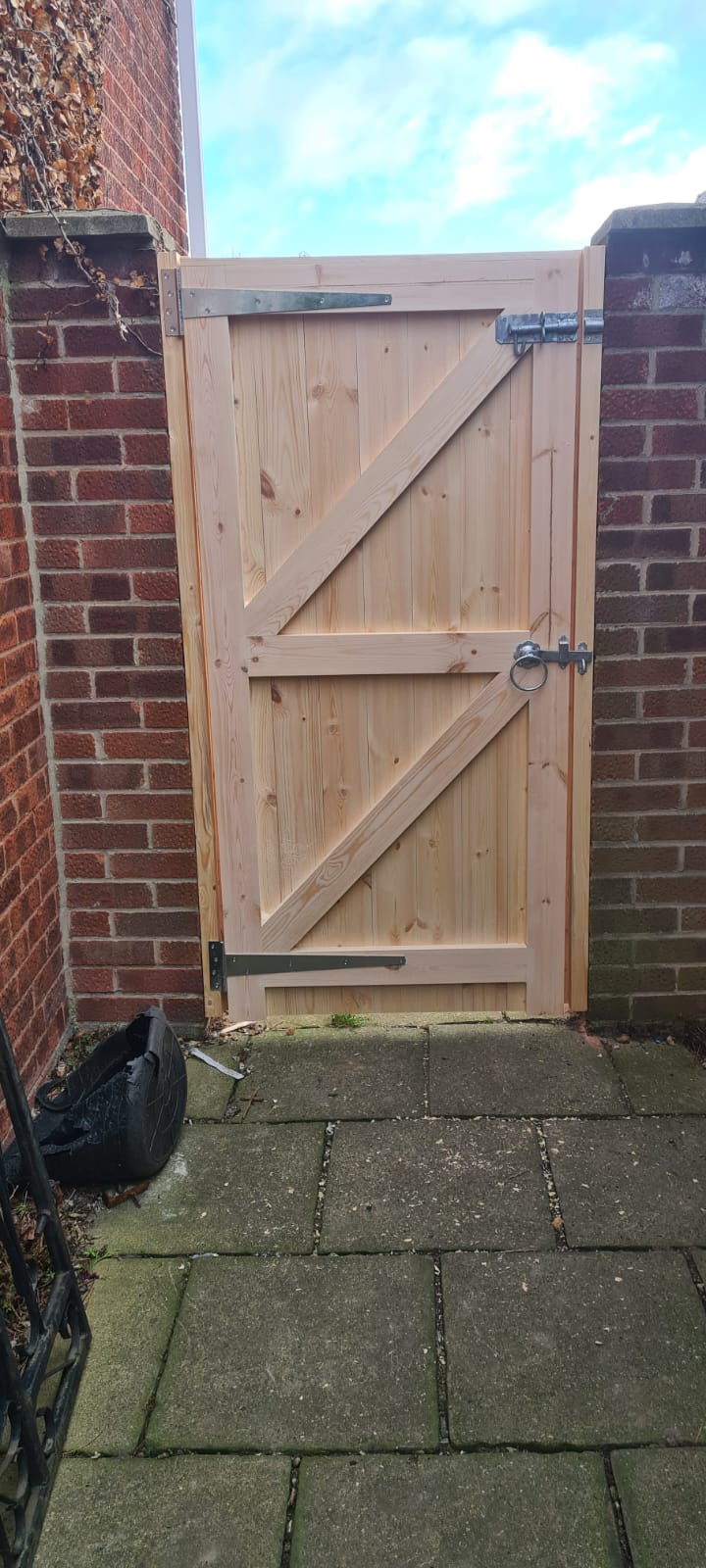
A single wooden gate can work well on a sloping entrance where the opening is not wide enough to justify a pair. Its greater width means it places more leverage on the hinge post, so the post size, footing and ironmongery must be selected accordingly.
On a slope, a lighter but well-built design is usually preferable to an unnecessarily heavy solid gate. The aim is not to cut corners on timber, but to avoid loading the hinges and post with more weight than the site requires.
Gate design and ground clearance matter as much as style
The bottom rail is the first part of a gate to meet a rising driveway. Before selecting a design, measure the height from the ground to the proposed bottom of the gate at several points across the opening. Then consider what happens to that clearance as each leaf opens.
A useful check is to make a simple full-size template from a straight timber batten. Fix or hold it at the proposed hinge point and swing it through the intended path. This quickly shows whether the gate will strike the ground. Your installer can carry out a more exact version of this assessment, particularly where automation is planned.
Open-boarded designs can be a sensible choice for a sloping entrance. They reduce wind loading while still creating a clear boundary, and their lighter appearance often suits rural and suburban properties alike. Closeboarded gates offer more privacy, but present a larger face to strong winds. On an exposed drive, that additional pressure should be allowed for in the posts, hinges and latching arrangement.
Do not compromise on posts and ironmongery
A gate is only as reliable as the structure supporting it. Sloping driveways often increase the forces acting on a gate because the leaves may need to be hung with non-standard clearance, special hinge positions or uneven ground levels.
Posts should be properly sized for the width and weight of the gates, set deep enough in suitable concrete foundations and checked for plumb before any gate is hung. On a driveway entrance, substantial timber posts are normally a better long-term choice than trying to fix heavy gates to a lightweight fence post or existing masonry of uncertain condition.
Adjustable hook and band hinges give useful scope for final alignment. They allow the installer to position the gates accurately, compensate for small variations and make later adjustments if timber settles naturally through the seasons. A strong centre stop, drop bolts and a suitable latch or lock are equally important. These details prevent the gates from moving in wind and keep the leaves meeting correctly when closed.
If gates are automated, the geometry needs even closer attention. An automation installer must confirm the opening angle, hinge position, power supply, safety devices and clearances before equipment is chosen. Adding motors to gates that already scrape, bind or sit out of line rarely ends well.
Why timber construction matters on a slope
Wooden gates need to withstand weather, daily movement and the constant pull placed on joints by their own weight. On a sloping driveway, where precise alignment is especially important, construction quality is not a small detail.
Look for properly jointed frames rather than gates held together mainly by surface screws. Mortice and tenon joints, hardwood dowels and exterior-grade D4 adhesive create a far stronger frame connection and help the gate remain square. Engineered timber is also a sound choice for driveway gates because it is designed for better stability than standard pressure-treated timber, while keeping the warmer character and more accessible price of softwood.
At M & D Woodcraft, gates are handmade to order, which allows the size, hanging arrangement and design to be considered for the actual entrance rather than forcing a non-standard driveway to suit an off-the-shelf gate. That is particularly valuable where a slope, old boundary walls or uneven levels leave little room for error.
Give the installer the right measurements
A good quote or gate order starts with more than the clear width between posts. Measure the opening at the top, middle and bottom, as older posts and walls are not always parallel. Record the proposed finished ground level, the direction of the slope, and how much room there is inside the property for gates to open.
Photographs taken square-on from the road and from inside the drive are helpful, alongside side-on pictures that show the incline. State whether the gates need to open inwards or outwards, whether vehicles need to pass through at a particular angle, and whether automation is planned now or may be added later.
It is also worth considering drainage. Water running down a drive can wash out ground at the entrance or leave standing water around posts and tracks. Dealing with this before the gates are fitted protects both the installation and the approach to your property.
Choose the gate around the site, not just the look
A well-made wooden gate can suit a sloping driveway beautifully, but the design has to respect the ground it sits on. Conventional inward-opening gates remain a strong option for gentle falls and level approaches. Sliding or bi-folding arrangements may be better where the rise is steep, the opening arc is restricted or automated access is a priority.
Take the time to measure the slope, plan the swing path and choose sound posts and ironmongery. The result will be a driveway entrance that closes properly, looks right from the road and continues to give a warm, solid welcome every time you come home.


Comments