


9 Best Wooden Driveway Gate Designs
- Mark C
- Jun 29
- 6 min read
A driveway gate changes the look of a property faster than most exterior upgrades. Get the design right and it adds privacy, security and a proper sense of arrival. Get it wrong and even a well-made gate can feel out of place. When customers ask about the best wooden driveway gate designs, the right answer usually starts with the house, the entrance width and how much privacy they actually want.
For some homes, a simple five bar gate is exactly right. For others, a taller boarded pair with a framed top suits the setting far better. Style matters, but so does construction. A gate that looks smart on day one still needs to cope with weather, regular use and the natural movement of timber over time.
What makes the best wooden driveway gate designs work
The strongest designs are not always the most ornate. In practice, the best gates strike a balance between appearance, strength and proportion. A wide opening needs a design that carries its weight properly. A gate facing open countryside may suit a more traditional agricultural look, while a suburban frontage often benefits from a neater, more private design.
Timber choice and build method matter just as much as the pattern on the front. Proper mortice and tenon joints, hardwood dowels and exterior-grade adhesive all help a gate stay solid for longer. Engineered timber can also make a real difference, giving better stability than standard pressure-treated timber while keeping costs more sensible than hardwood.
That is why choosing by photograph alone can be misleading. Two gates may look similar, but perform very differently once fitted and exposed to the British weather.
Best wooden driveway gate designs for different homes
Five bar gates
The five bar design remains a favourite for rural and semi-rural properties. It has an open, traditional look that suits farmhouses, cottages and homes with long drives. Because it allows visibility through the gate, it feels lighter and less imposing than fully boarded designs.
It is also a practical choice where wind exposure is an issue. Less solid surface means less wind resistance, which can be kinder to hinges, posts and automation systems. The trade-off is privacy. If you want to screen the driveway or front garden, a five bar gate will not do that.
Framed ledge and brace gates
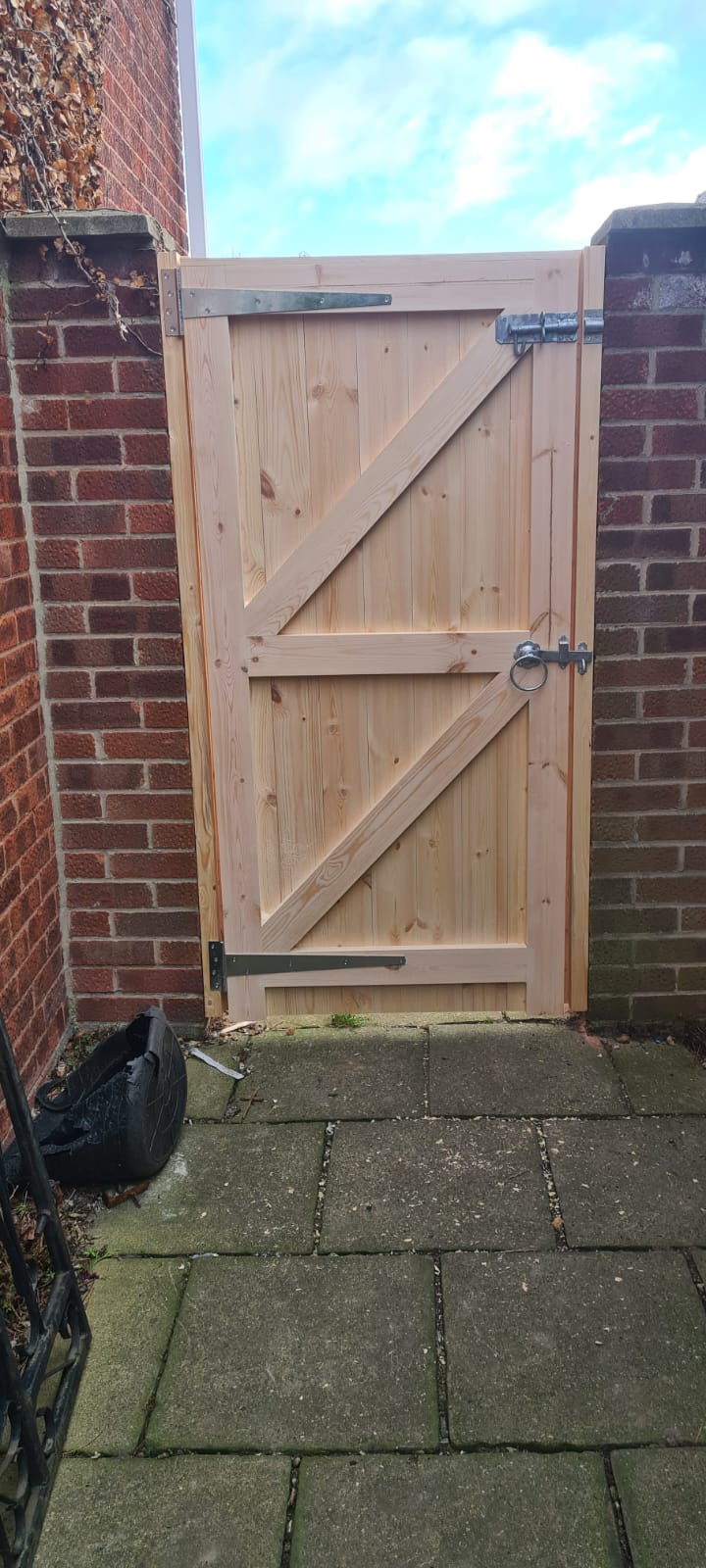
For a straightforward traditional appearance, framed ledge and brace styles are dependable and versatile. They suit many period homes and can work just as well on newer properties if the detailing is kept simple. Vertical boarding gives a clean face, while the frame adds structure and definition.
This style is often chosen by homeowners who want privacy without anything too decorative. It is honest, solid and practical. If made to measure, it can also be adapted easily for awkward openings or sloping drives.
Tongue and groove boarded gates
If privacy is high on the list, tongue and groove gates are among the best wooden driveway gate designs to consider. The close-fitting boards create a more enclosed frontage and a smarter, more finished look. They are especially popular on detached homes where the driveway sits close to the road.
These gates tend to feel more substantial, which many customers like. The trade-off is weight. A fully boarded driveway gate needs sound construction and the right ironmongery to support it properly. Wide pairs in particular should never be treated as a lightweight job.
Arched top gates
An arched top can soften the look of a gate and add a more distinctive entrance. It works well on traditional properties and can help a broad driveway opening feel less flat or boxy. A gentle rise is usually more timeless than a dramatic curve.
The key is keeping the proportions right. Too much arch on a modest property can look overdone. On the right house, though, an arched top brings a touch of character without losing practicality.
Swan neck and shaped top gates
For homeowners who want a stronger design feature, swan neck or shaped tops give a more decorative finish. These styles often suit larger homes, formal entrances and properties with brick piers. They can look particularly effective when paired with matching pedestrian gates.
This is one of those it depends choices. A shaped top can lift the whole frontage, but only if the setting supports it. On a simple driveway with plain fencing, a more restrained design may look better and age better.
Paling and open board gates
Open board and paling styles are useful when you want a traditional timber gate that feels less closed in. They offer more privacy than a five bar design but still let in light and visibility. For homes that do not want a heavy solid frontage, they can be an excellent middle ground.
They also suit cottage-style properties and village settings particularly well. The overall effect is softer and more relaxed than a fully boarded gate.
Choosing between open and solid designs
This is often the first real decision. Open designs, such as five bar and some paling gates, keep the entrance lighter and usually cope better in exposed locations. They suit larger plots where screening is less important and where the gate is part of the landscape rather than a boundary wall.
Solid or near-solid designs create more privacy and can make a property feel more secure from the road. They also give a stronger visual statement. The downside is added weight and greater wind loading, which means build quality and fitting become even more important.
For many suburban homes, a semi-solid design is the sweet spot. It gives presence and a degree of screening without making the frontage feel too closed off.
Why proportions matter as much as style
A good gate design can still look wrong if the proportions are off. Height, width and rail spacing all affect the final result. Gates that are too low can appear mean against a wide entrance. Gates that are too tall can feel oppressive, especially at the front of the house.
Double driveway gates need particular care. Each leaf must be built for the span it covers, and the overall design should not become clumsy once scaled up. This is where bespoke manufacturing earns its keep. Standard off-the-shelf sizes rarely suit every entrance properly, especially on older properties where openings are rarely exact.
The same applies to gate posts, hinges and latches. A fine-looking gate is only as dependable as the support behind it.
Construction details worth paying attention to
When comparing the best wooden driveway gate designs, the visible style is only part of the story. The better question is how the gate has been made. Traditional mortice and tenon joinery gives a stronger framework than basic screwed construction. D4 exterior glue adds durability in wet conditions, and hardwood dowels help reinforce key joints.
Engineered timber is also worth serious consideration. It offers improved stability and can reduce the twisting and movement often seen in cheaper softwood gates. For homeowners who want a gate that keeps its shape better over time, it is a sensible option.
At M & D Woodcraft Ltd, this sort of build detail is central to the product, not an extra. That matters because driveway gates live hard lives. They are opened in rain, exposed to frost, hit by sun and asked to hold their line year after year.
Matching the gate to the property
The most successful driveway gates look as though they belong. On brick-fronted homes, a framed boarded gate often gives enough structure to tie in with the masonry. On rendered cottages, softer lines and lighter detailing can feel more natural. For modern homes, cleaner vertical boards and simpler tops usually work better than decorative shaping.
Colour and finish also play a part. Some homeowners prefer a natural timber look with oil, while others want a painted or primed finish ready for the final coat. There is no single right answer, but it pays to think ahead about maintenance as well as appearance.
A gate should complement the house, not compete with it. If the property already has strong period features, a simpler gate can often be the better choice.
A final thought on choosing well
The best design is the one that suits your entrance, gives you the right balance of privacy and openness, and is built properly enough to last. A handsome gate is easy to admire in a picture. A well-made gate that fits the opening, works with the house and stands up to British weather is the one you will still be pleased with years later.


Comments