

Best Stair Gates for Banisters for Safer Stairs
- Mark C
- 5 days ago
- 6 min read
A stair gate is only as safe as the point it is fixed to. That is why the best stair gates for banisters are not simply the first standard-width gate that fits between two uprights. The handrail position, newel post size, spindle spacing, skirting and wall construction all affect whether a gate can be fitted firmly and used safely every day.
For many homes, particularly older properties and staircases with non-standard layouts, a made-to-measure wooden gate gives a neater and more dependable answer than forcing a mass-produced gate into place. The aim is straightforward: a properly secured barrier that protects little ones and pets without spoiling the character of the staircase or putting unnecessary strain on the banister.
What makes a stair gate suitable for banisters?
A banister is not the same as a solid wall. Spindles are often too narrow to take direct fixings, handrails may be shaped or angled, and decorative timber can be damaged by poorly chosen clamps. Before choosing a gate, establish exactly where its hinges and catch will sit. In the best arrangement, both sides of the opening provide sound, substantial fixing points.
A full newel post is usually the strongest option at the stair side. On the opposite side, a solid wall, a purpose-made mounting board or another suitably strong post can provide the fixing point. Where a gate must meet a balustrade rather than a wall, an adapter or timber mounting solution may be needed to create a flat, secure surface. It should be fitted in line with the gate maker's instructions, rather than improvised with loose packing pieces.
The gate itself needs to be the right width for the finished opening, not the advertised width of a standard product. Measure between the actual fixing faces at more than one point. Stair openings can be out of square, especially in period houses, and skirting boards can make the lower measurement narrower than the upper one.
Best stair gates for banisters: the features that matter
There is no single best choice for every staircase. A narrow, modern landing with square newel posts has different needs from a Victorian hall with turned spindles and a curved handrail. However, a few features should be treated as essentials rather than extras.
A secure, purpose-designed fixing method
At the top of a staircase, a gate should be securely fixed and specifically intended for that location. A gate that relies solely on pressure can shift under repeated use or if it receives a determined push. A properly hinged wooden gate, fixed to sound timber or masonry, is generally the more permanent option where the layout allows.
Avoid drilling straight into slender spindles or relying on the handrail alone. The timber may split, the fixing may loosen, and the gate can become misaligned. If there is no solid fixing face, a fitted post or carefully installed banister adapter gives the gate something substantial to work against.
A latch that adults can use confidently
The latch should be simple for an adult to operate one-handed, yet not easy for a child to release. This matters when carrying a baby, laundry basket or shopping up the stairs. Check the latch position before ordering, particularly if the gate is to be fitted close to a wall, bulky skirting or a stair rail.
A self-closing mechanism can be useful in a busy family home, but it is not a substitute for checking that the gate has fully latched. If you prefer a traditional timber gate, a well-made catch and a clear closing routine can be equally practical. Choose the arrangement that suits how your household actually uses the stairs.
The correct opening direction
At the top of the stairs, the gate should not open out over the stair flight. It should open onto the landing, away from the drop, so there is no risk of stepping around an open gate with no landing beneath your feet. This detail needs deciding before the gate is made, because the hinge side, latch side and available clearance all play a part.
At the bottom of the stairs, there is usually more flexibility. Even so, make sure the open gate does not block a hallway, strike a radiator or clash with an internal door. A made-to-order gate can be planned around the direction of travel instead of asking the household to adapt to an awkward fitting.
Sensible gaps and a climb-resistant design
Look at the clear space below the gate, beside the latch and between any vertical rails. Gaps should be small and consistent, without a tempting large opening created by uneven flooring or a poorly positioned mounting board. The gate should also be high enough for its intended use and built without horizontal features that make an easy foothold for a climbing child.
For child safety, choose a product designed and tested as a safety barrier where this is the gate's primary purpose. Check the manufacturer's age guidance, fitting instructions and applicable safety standard information. A handsome gate is not enough if the construction or fitting method is unsuitable for the job.
Why timber works well on a traditional staircase
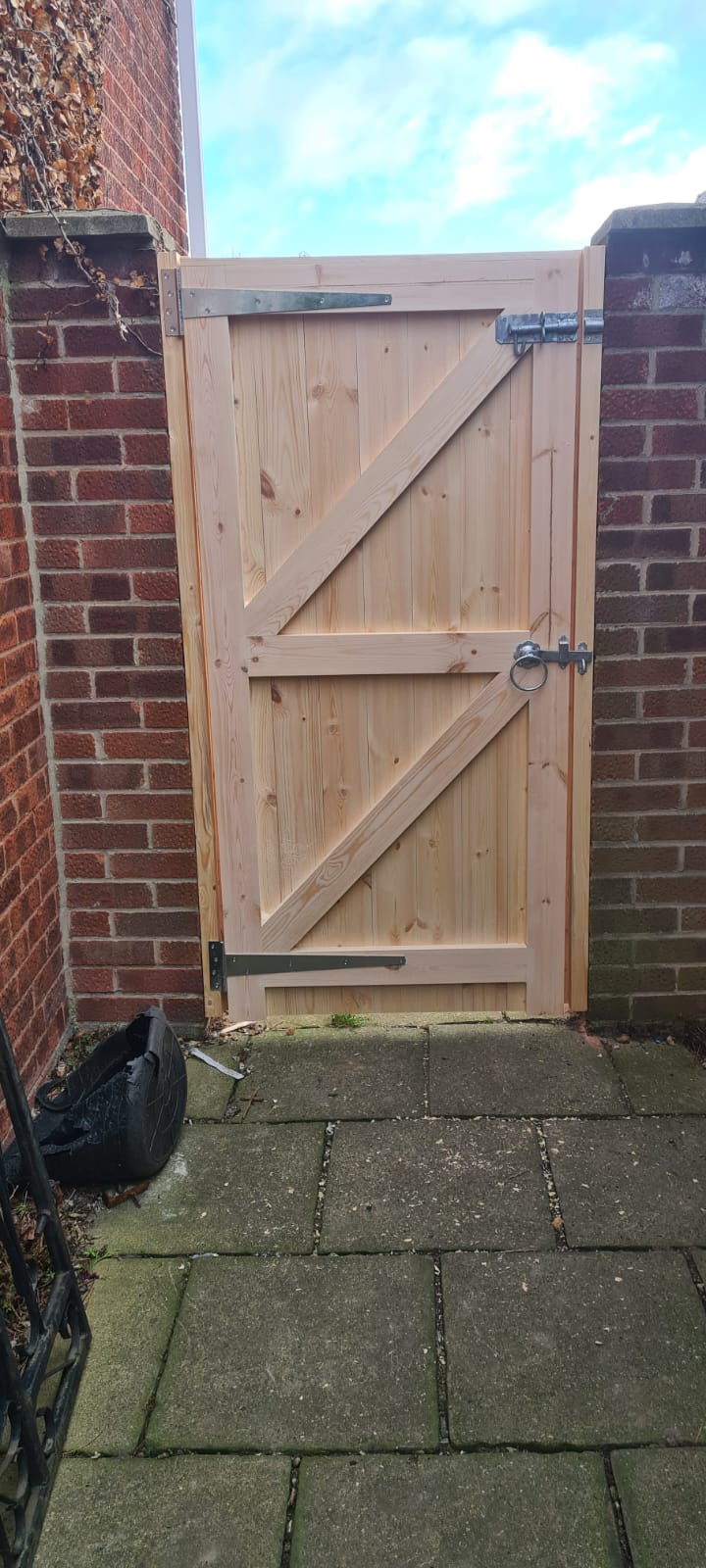
A wooden stair gate can look like it belongs in the house rather than like an afterthought. This is especially valuable where there are painted stair strings, oak handrails, turned newels or period joinery to consider. Timber can be made to a precise width and finished to complement the surrounding woodwork, whether that means a natural oiled appearance or a painted finish.
Appearance is only part of the case for timber. Construction matters. A gate with mortice and tenon joints, hardwood dowels and exterior-grade D4 adhesive is designed as joinery, not as a few lightweight pieces screwed together. It gives the frame strength to cope with regular opening and closing, while engineered timber helps reduce movement compared with ordinary pressure-treated softwood.
No timber is maintenance-free indoors, particularly near a front door where damp coats, muddy paws and changes in temperature are common. A sealed, painted or oiled finish makes cleaning easier and helps keep the gate looking well cared for. Check hinges and catches from time to time too. Any gate, whatever its material, deserves a quick inspection if it starts to sag, bind or rattle.
Measure before you choose the style
Take measurements after deciding how the gate will be mounted. Measure the width between finished fixing points at the top, middle and bottom, then use the smallest measurement unless the opening will be corrected with a fitted mounting board. Record the height of the handrail, the depth of skirting, the position of any dado rail and whether the floor is level.
Photographs are useful when requesting advice, particularly one taken square-on to the opening and another from the side showing the newel post, handrail and skirting. Include a tape measure in the image where possible. It helps identify problems such as a projecting rail or a wall that is not flush before a gate reaches your home.
Do not overlook the room needed for hinges and the swing of the gate. A narrow landing may call for a particular opening direction or a gate that sits within, rather than across, the opening. If the staircase is unusually wide, angled or split-level, bespoke manufacture is often simpler and tidier than adding several extension panels.
Common mistakes to avoid
The most common mistake is treating the banister as a universal fixing point. A gate can appear firm on the day it is installed but work loose once it has been pushed, leaned on and opened hundreds of times. Fix to suitable structure, and follow the supplied instructions closely.
Another is buying for the width alone. A gate may span the opening yet still foul the handrail, leave an excessive gap at the skirting or open the wrong way. Finally, avoid choosing purely on price. A stair gate is used at the point where a fall could happen, so the quality of the timber, joinery, fixings and fitting plan deserves proper attention.
For awkward staircases, the right answer is often a gate made around the banister rather than a banister altered to suit a gate. M & D Woodcraft can make wooden stair gates to order, allowing homeowners to specify the opening size and discuss the practical details before manufacture. A few careful measurements and an honest look at the fixing points will lead to a gate that feels secure, works smoothly and sits comfortably within the home for years to come.


Comments